Nestled among the rolling hills of Woodstock, Vermont, Marsh-Billings-Rockefeller National Historical Park tells one of the most important stories in American history—the birth of conservation. While many visitors come to Woodstock for its picturesque New England charm, this unique national park offers something far more significant: a chance to explore how Americans first learned to protect forests, landscapes, and natural resources for future generations.

Established on August 26, 1992, Marsh-Billings-Rockefeller National Historical Park is the only unit of the National Park System dedicated to interpreting the history of conservation stewardship in the United States. Through the lives of George Perkins Marsh, Frederick Billings, and Laurance and Mary Rockefeller, visitors can trace the evolution of conservation ideas that helped shape modern environmental policy and the national parks we enjoy today.
Why Marsh-Billings-Rockefeller National Historical Park Matters
Long before conservation became a national movement, many Americans believed the country’s forests and natural resources were virtually limitless. By the mid-1800s, however, widespread logging and land clearing had begun transforming landscapes across the United States and Europe.
The story of Marsh-Billings-Rockefeller National Historical Park follows three generations of conservation-minded leaders who recognized these dangers and worked to promote responsible stewardship of the land. Their ideas influenced forestry practices, conservation policies, and ultimately the protection of some of America’s most treasured landscapes.
George Perkins Marsh: America’s First Conservationist
Born in Woodstock in 1801, George Perkins Marsh grew up on the property that would eventually become the national historical park.

A gifted scholar, Marsh was a philologist who reportedly spoke more than twenty languages. Following in the footsteps of his father, Charles Marsh, he served in the United States House of Representatives before embarking on a diplomatic career. President Zachary Taylor appointed him ambassador to the Ottoman Empire in 1850, and President Abraham Lincoln later named him ambassador to Italy in 1861.
During his travels throughout Europe and the Mediterranean, Marsh witnessed firsthand the devastating effects of deforestation. Hillsides stripped of trees suffered severe erosion, flooding, and declining agricultural productivity.
Concerned that similar damage could occur in the United States, Marsh wrote Man and Nature in 1864. The book argued that humans could permanently alter and damage the natural environment if resources were not managed responsibly. Historians widely regard Man and Nature as one of the foundational texts of the American conservation movement.
Today, Marsh is often called the father of American conservation.
Frederick Billings: Putting Conservation into Practice
The next chapter in the property’s story belongs to Frederick H. Billings.
Born in Vermont in 1823, Billings traveled to California during the Gold Rush and built a successful legal and business career. Among his early clients was John Sutter, whose sawmill became famous after the discovery of gold in California.

Billings eventually became president of the Northern Pacific Railway and amassed considerable wealth. In 1869, he purchased the Marsh estate and began transforming the surrounding landscape according to the conservation principles outlined in Man and Nature.
At a time when much of Vermont’s forest had been cleared for agriculture, Billings pioneered scientific forest management and large-scale reforestation efforts. His work helped demonstrate that forests could be both economically productive and environmentally sustainable.
Billings also established a model farm on the property, which survives today as the neighboring Billings Farm & Museum. Visitors can still experience Vermont’s agricultural heritage while exploring the conservation legacy of the estate.
To enhance the landscape, Billings constructed approximately fourteen miles of carriage roads through the forests and hills surrounding the mansion. Many of these routes remain popular hiking trails today.
The Rockefeller Legacy
The final chapter in the park’s story centers on Mary Billings French and her husband, Laurance Rockefeller.
Mary was Frederick Billings’ granddaughter, while Laurance was the son of John D. Rockefeller Jr. and grandson of Standard Oil founder John D. Rockefeller.

Laurance Rockefeller became one of America’s most influential conservationists and philanthropists. Throughout his life, he supported national parks, protected open spaces, and advocated for environmental stewardship. His conservation efforts helped preserve lands across the country, including important areas associated with the National Park System.
In 1992, Mary and Laurance Rockefeller donated the estate to the National Park Service. Their gift created Marsh-Billings-Rockefeller National Historical Park, ensuring that future generations could learn about the people and ideas that shaped conservation in America.
Visiting Marsh-Billings-Rockefeller National Historical Park
Visitor parking is located across the street at Billings Farm & Museum. After crossing the road, stop first at the Carriage Barn Visitor Center.
Originally constructed in 1895, the restored barn now houses exhibits that explain the development of conservation in the United States. The visitor center also serves as the starting point for guided mansion tours and ranger-led programs.
Even if you’re short on time, the exhibits provide valuable context for understanding the significance of the estate.


Marsh-Billings-Rockefeller Mansion
The centerpiece of the park is the impressive Marsh-Billings-Rockefeller Mansion. Originally constructed in 1805 by Charles Marsh in the Federal architectural style, the home was later expanded and transformed into the Queen Anne-style mansion visitors see today. Frederick Billings oversaw major additions to the property, while later generations carefully preserved the estate. the mansion.

Because the mansion remained a private residence until the creation of the park, many of the rooms retain their original furnishings and personal touches.
Guided tours are typically offered from May through October and provide one of the best opportunities to experience the property’s rich history. Unfortunately, our visit coincided with a trip to Manchester-Boston Regional Airport, leaving us without enough time to tour the interior. It’s definitely at the top of our list for a return visit.
Beautiful Formal Gardens
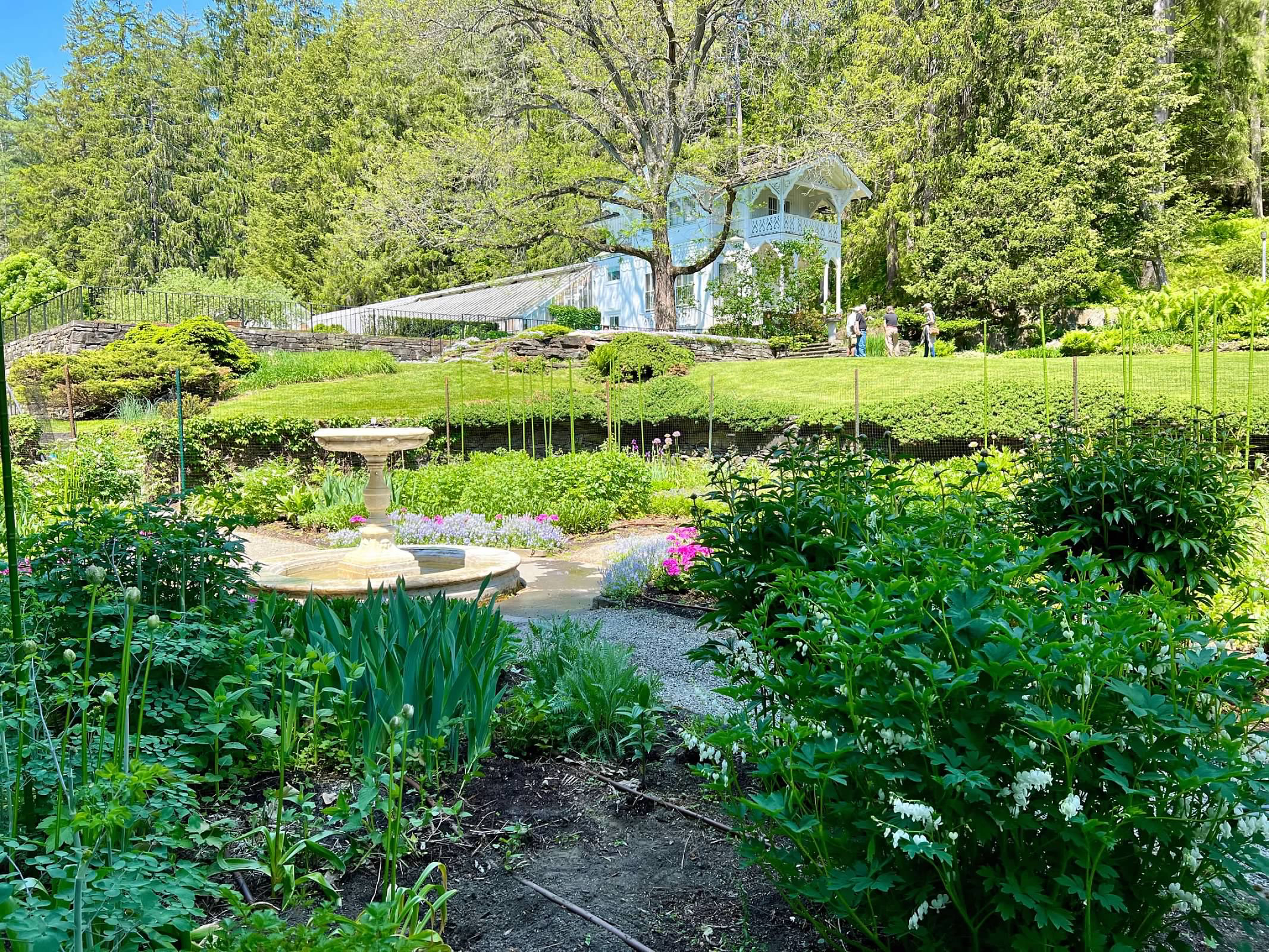
One of our favorite parts of the park was exploring the formal gardens surrounding the mansion.
Visitors familiar with Mount Desert Island and Acadia National Park, may recognize similarities to other Rockefeller landscapes. The family had a deep appreciation for carefully designed gardens that blended beauty with the surrounding natural environment.
The gardens provide a peaceful place to stroll while enjoying seasonal flowers, historic plantings, and scenic views of the estate.

The Fascinating Belvedere Complex
One of the more unexpected features of the estate is the Belvedere Complex.
Originally constructed during the 1870s, the complex included recreational amenities such as a bowling alley and swimming pool. During the Cold War era, the Rockefellers renovated portions of the structure to include a nuclear fallout shelter and a soda fountain.
The unusual combination offers an interesting glimpse into both twentieth-century leisure and Cold War history.

Hiking Trails and Forests
The conservation story comes alive on the park’s trail system.
More than twenty miles of trails wind through managed forests, past historic carriage roads, and toward popular destinations such as the Pogue, a scenic mountain pond, and Mount Tom, which offers panoramic views of Woodstock and the surrounding countryside.


These trails allow visitors to experience firsthand the forests that Frederick Billings worked so hard to restore.
If you’re traveling with a dog, you’ll be happy to know that many trails are pet-friendly. Dogs are welcome on leash, making this an excellent stop for visitors exploring Vermont with their four-legged companions.
Final Thoughts
Marsh-Billings-Rockefeller National Historical Park is much more than a historic estate. It is a place where visitors can trace the origins of America’s conservation movement and learn how visionary leaders helped shape the way we manage forests, parks, and natural resources today.
Whether you’re interested in history, architecture, hiking, gardening, conservation, or simply exploring one of Vermont’s most beautiful landscapes, this unique national park deserves a place on your New England travel itinerary.
For anyone who loves national parks, a visit here offers a deeper understanding of why conservation matters—and how a few dedicated individuals helped preserve America’s natural treasures for future generations.
Click here for more Land of Liberty Explorers! Also, don’t forget to follow us on Facebook and Pinterest!

Updated June 19, 2026